
AusCham Attends Vietnam Economic Forum 2025: Insights on Sustainable Growth and Prospects for 2026
Hanoi, 16 December, 2025 – AusCham Vietnam attended the Vietnam Economic Forum 2025: Prospects for 2026, with Ms Huong Tran, Head of Advocacy & Partnerships, participating on behalf of the Chamber.
The Forum convened senior government leaders, policymakers, economists, and business representatives to discuss a central question shaping Vietnam’s development agenda: how to achieve rapid economic growth while ensuring sustainability, resilience, and inclusiveness.
At the Forum, Vietnam reaffirmed its ambitious growth targets, aiming for at least 8% GDP growth in 2025 and double-digit growth during 2026–2030, as part of its long-term strategy to become an upper-middle-income country by 2030 and a high-income economy by 2045. Discussions highlighted confidence that these targets are achievable, provided growth is underpinned by strong institutions, effective policy coordination, and improved productivity.
Prime Minister Pham Minh Chinh highlighted that Vietnam’s development goals are both “well-grounded and feasible”, emphasising that the country has identified the dual priorities of green transition and digital transformation as “an objective necessity, a strategic choice and a top priority”, forming the foundation of its growth strategy.
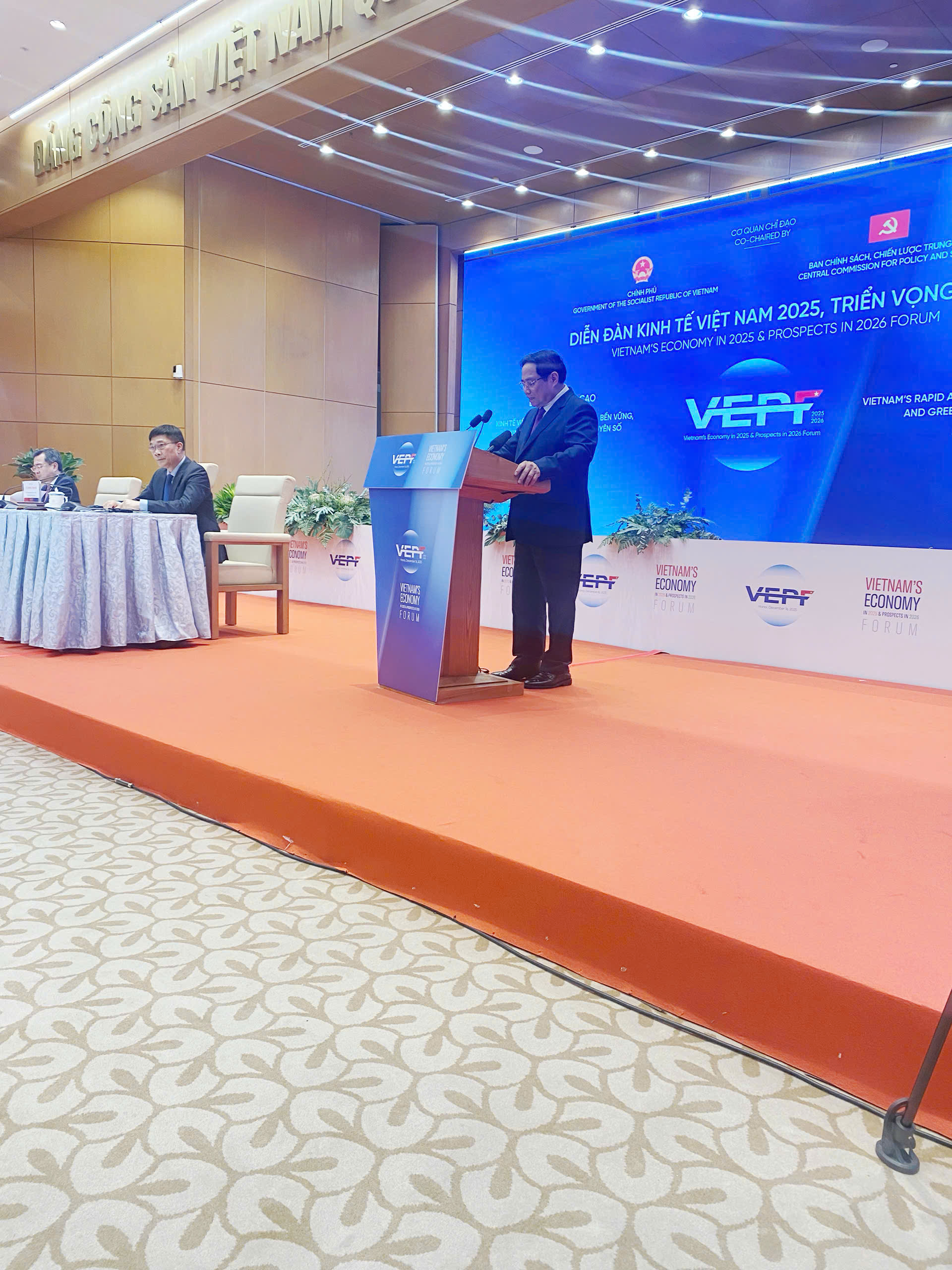
He underscored that these dual transitions will serve as “a key driving force for rapid and sustainable development,” supported by policy commitments and strategic reforms outlined in national resolutions.
In addition, the Prime Minister reaffirmed that Vietnam is pursuing rapid, sustainable and resilient growth on the basis of science, technology, innovation, and productivity, rather than growth driven primarily by capital and labour alone.
Key themes discussed at the Forum included:
Capital mobilisation and efficient use of resources — critical to underpin higher growth and investment across sectors.
Deepening capital markets and policy coordination — with strengthened fiscal and monetary alignment to boost investor confidence.
Digital transformation and green transition — highlighted as interconnected pillars of future growth to help the economy adapt to climate change while advancing productivity.
Circular economy approaches — particularly in plastics and materials management — increasingly recognised as integral to economic growth and sustainability.
Collaboration across sectors — including government, business, finance, and communities, is essential to de-risk investments and scale innovation.
AusCham welcomes these policy directions and notes strong alignment with areas where Australian businesses can contribute expertise, including sustainable finance, clean energy, digital solutions, innovation, and circular economy models. AusCham will continue to engage with stakeholders to support dialogue and practical policy implementation that enables sustainable, high-quality growth for Vietnam in the years ahead.
Key Takeaways from the Forum
Vietnam’s high-growth targets are considered achievable if growth quality and productivity are strengthened.
Effective capital mobilisation and deeper capital markets are essential to sustain long-term growth.
Future growth must be driven by innovation, technology, and productivity improvements.
Stronger coordination between fiscal, monetary, and regulatory policies will improve investor confidence.
Digital transformation and green transition are core, interconnected pillars of sustainable development.
The circular economy is emerging as a mainstream economic growth strategy.
Scaling circular solutions requires patient capital, policy clarity, and cross-sector collaboration.